
6 posts tagged with "Feature announcements"

View All Tags

Announcing ‘Progress Reports’ in DUOS! Renew Access & Share Your Research Faster

· 2 min read

DUOS streamlines the process of sharing and requesting data, and is now expanding institutions’ and researchers’ ability to renew their access to datasets, and share their research with the scientific community!  

Why ‘Progress Reports’?​

When using controlled-access data, access is typically granted for one year by a data access committee (DAC). To help researchers extend their data access as needed, assist DACs in overseeing and enabling data use, and share details on the important research progress by DUOS users, DUOS introduces Progress Reports.  

Before Progress Reports, researchers in DUOS needed to make a new Data Access Request to extend data access, which put redundant administrative work on researchers and left DACs with less than desirable data linkage and research output information. Now with Progress Reports in DUOS, access renewals, research updates, publications, presentations, collaborator changes, data management incidents and closeouts linked to the original DAR in a single auditable and shareable provenance chain – lightening the work on researchers and DACs to share data and research results faster! 

How do Progress Reports benefit different users in DUOS?​

In DUOS…
ResearchersSubmit DARs, Progress Reports, DMIs, and DAR Closeouts
DACsReview DARs, Progress Reports, DMIs, and DAR Closeouts
Signing OfficialsAudit DARs, Progress Reports, DMIs, and approve DAR Closeouts

When Should Researchers Submit a Progress Report?​

In DUOS, your access to data via a DAR will expire 12 months after initial approval. DUOS will send the PI on the DAR a reminder to complete a Progress Report, to either renew access or closeout the DAR, 30 days prior to the DAR’s expiration. If you do not submit and receive approval for your Progress Report before the expiration, your access will suspended until a Progress Report is approved, or you submit a new DAR for the data. 

Additionally, researchers can submit Progress Reports at-will to update DACs of exciting developments in their research, including sharing information about presentations, publications, or intellectual property developed in the course of their research. This information will be shared publicly and promoted by DUOS to help draw attention to your research!
We hope you enjoy this new feature and we look forward to sharing your research with the world!​

Filter data by Data Use & Access terms, DACs, and Data Types

· One min read

Finding the right dataset just got easier in DUOS!

We’ve added powerful new search filters that help you quickly narrow down datasets by the criteria that matter most. You can now filter data by:

  • Data Use & Access terms – Find datasets that align with specific research purposes or consent requirements
  • Data Access Committees (DACs) – View datasets stewarded by specific DACs for easier coordination and transparency
  • Data Types – Focus your search on genomics, phenotypic, clinical, or other data types relevant to your research

These filters make it faster to discover the right data, streamline your access workflows, and ensure you’re working with datasets that meet your project needs.

Try the new filters today—log in to DUOS and start exploring with precision!

Create Your Own Branded & Curated Data Library in DUOS!

· One min read

We’re excited to announce a powerful new feature in DUOS: the ability to create your own branded and curated Data Library! Now, organizations and research groups can showcase their datasets with a customized look and feel—tailored to reflect their unique identity and mission.

With this feature, you can:

  • Design a branded landing page for your data collections
  • Curate datasets to highlight key themes or research areas
  • Guide users directly to data that matters most to your community

Whether you’re amplifying your research impact or simplifying access to your data resources, this new capability makes it easier than ever to connect researchers with the data they need.

Check out some examples on the DUOS homepage, and if you’re interested in creating a branded Data Library in DUOS to showcase your research and share your data contact us via the homepage to let us know!

DUOS Introduces Automatic Access Permission Updates with TDR

· 3 min read

Introduction​

Data access for researchers is critical to modern scientific endeavors. But new data access requests are hampered by an often cumbersome and manual process. Now, DUOS (Data Use Oversight System) automatically updates users’ access permissions, simplifying and expediting the process for researchers, ensuring they can swiftly and securely access the data they need. In this blog post, we explore the benefits and implications of the new automatic access permission update feature in DUOS, and link to resources to leverage DUOS to streamline data access.

The Current Data Access Landscape​

Data access committees (DACs) and Data Custodians play a crucial role in managing the flow of valuable research data, ensuring the data is used ethically and responsibly. Traditionally, researchers had to manually request updates to their access permissions from the DAC when they were granted secondary access to new datasets. DACs, the centerpiece of the approval process, were overwhelmed by exponentially increasing amounts of data and data requests. The cumbersome process often led to delays and hindered the timely advancement of research initiatives.

DUOS’ Automatic Access Permission Updates​

DUOS has emerged as a leading software platform for facilitating data access and management. Now, DUOS automatically updates researchers’ access permissions when they are approved for secondary access to requested research data. This eliminates the need for manual intervention, allowing researchers to seamlessly access the approved data without any delays. By streamlining the data access process, DUOS empowers researchers to focus on their work rather than navigating administrative barriers.

How Automatic Access Updates Benefit Researchers​

  • Expedited research process, as scientists can access new data promptly upon approval. 
  • Automation reduces the administrative burden on researchers, freeing up more time for analysis and experimentation
  • Increased efficiency ensures that researchers can focus on their science

Strengthening Data Security and Privacy​

DACs and Data Custodians know manual access permission updates carry an inherent risk of human error or data breaches. DUOS’ automated permission updates ensure that access permissions are updated accurately, promptly, and in compliance with privacy regulations, reducing the chances of data mishandling, and safeguarding sensitive information.

Conclusion​

DUOS’ automatic access permission update marks a significant milestone in the realm of data access and management. By simplifying the process and enhancing security, researchers can focus on their core scientific pursuits and data custodians can ensure efficient, broad and secure access to their datasets. As DUOS continues to innovate and streamline data access, it promises to revolutionize the landscape of research, empowering scientists worldwide in their quest for knowledge and breakthrough discoveries.

DACs and Data Custodians can learn more about how to leverage this new feature here.

Expediting scientific discovery by streamlining data access with DUOS

· 4 min read

Currently, the amount of available genomic data and the number of skilled researchers with the right tools to analyze it has significantly increased, leading requests for this data to increase exponentially. However, the world is losing out on valuable opportunities to transform this data into scientific insights that improve human health due to unnecessarily cumbersome data access processes.

A major bottleneck to scientific impact​

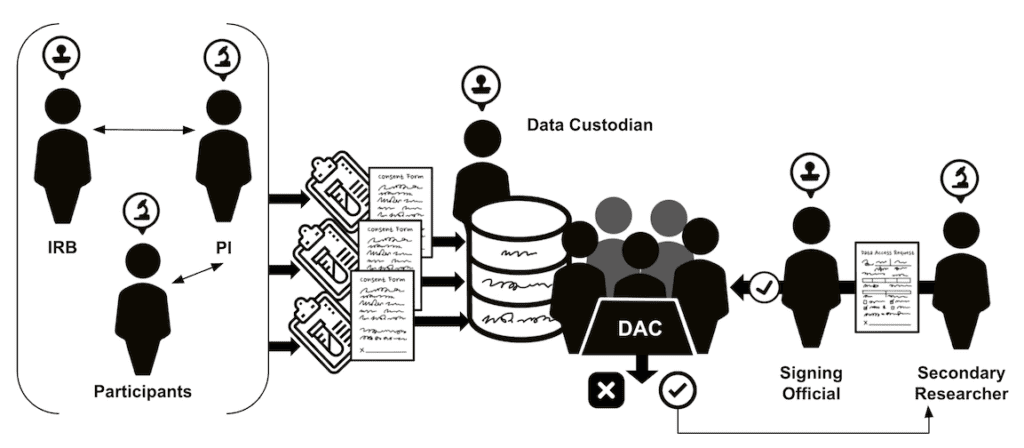
Genomic data for human participants is highly identifiable and therefore often categorized as controlled-access data by virtue of the data sharing language in its consent forms. This means access to the data must be regulated by a data access committee (DAC) who assures the data will be shared and used in accordance with the data use terms in the consent forms.

Therefore, researchers must apply for access to such datasets through their designated DAC. In turn, the DAC must review the application to ensure that the researcher’s intended use of the data aligns with the permitted uses of the data, per the participants’ consent. Unfortunately, since the DACs receive language describing permitted data use and intended use from different parties (IRBs/participants vs. researchers) who use unique and sometimes ambiguous language, they are left with an apples:oranges comparison, which is difficult for them to decipher.

Current data access processes rely on unique, custom narrative text to describe data uses in consent forms and the datasets they represent, as well as in data access requests for those datasets. This makes adjudicating requests difficult if not impossible for DACs in certain cases.

The added weight of the liability involved in granting someone access to data under uncertain terms often leads DACs to undershare rather than overshare, meaning data is unnecessarily locked down, delaying or blocking significant scientific impact entirely. 

Facilitating data access for researchers, by enhancing DAC workflows​

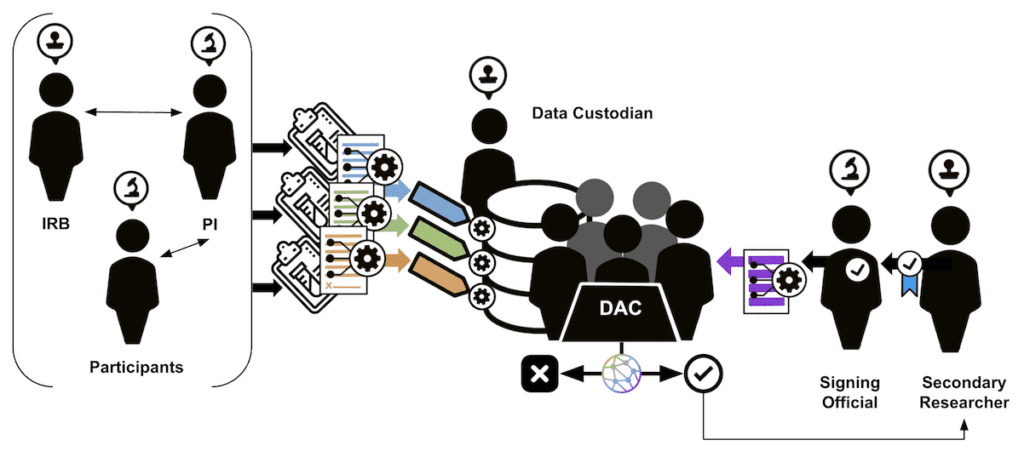
To address this issue and others like it, the Broad Institute developed DUOS (Data Use Oversight System), a suite of software services and policies for managing data access and sharing (more detail here). Principally, DUOS aims to consistently and transparently answer the overarching question posed to DACs: “Does the researcher’s intended use align with the permitted use of the dataset?”

In fact, DUOS aims to do this in a semi-automated fashion by leveraging the GA4GH Data Use Ontology (DUO). The GA4GH DUO provides both human-readable and machine-readable terms and definitions for data use. DUOS utilizes the GA4GH DUO to tag datasets with their permitted use, and data access requests with their intended use in human-readable and machine-readable terms. This standardization allows for DACs and the DUOS matching algorithm to easily determine if a researcher’s intended use aligns with a dataset’s permitted uses in a more apples:apples format, and allows for DUOS to leverage a matching algorithm to suggest a decision to the DAC. The DUOS team is working to further increase the accuracy of the algorithm in making a decision that aligns with that of the DAC. 

The GA4GH DUO allows for standardizing data use in consent forms and the datasets they represent, as well as in data access requests for those datasets. With data use language expressed in standardized and machine-readable terms, adjudicating requests is much easier for DACs and even possible to automate algorithmically.

While this automated matching can alleviate a serious bottleneck, other hurdles and data access and sharing remain. We aim to address those concerns in future articles and through our work on DUOS. In the meantime, please visit our website at www.duos.org for more information and detailed documentation. Thanks for reading and we hope DUOS serves you well!

Broad Institute Expands Data Access Committee to Foster Collaborative Genomic Research

· 2 min read

Cambridge, MA — Broad Institute, a pioneering institution at the forefront of genomic research and data governance, is proud to announce the expansion of its highly regarded Data Access Committee. After five successful years of governing access to internally generated genomic datasets, Broad Institute is opening its doors to welcome researchers and institutions from around the world to leverage its expertise, experience, and established policies.

In response to recent policy initiatives emphasizing the importance of data sharing and the growing need for support from smaller institutions unable to establish their own committees, Broad Institute’s executive committee has made a forward-thinking decision to allow external submissions of genomic data to its Data Access Committee. This groundbreaking development will enable researchers, institutions, and organizations to benefit from our institution’s exceptional resources and knowledge.

By opening the doors to external data submissions, Broad Institute aims to foster a culture of collaboration and innovation in genomic research. This initiative represents a significant opportunity for institutions of all sizes to tap into our institution’s existing system, policies, and wealth of experience. The Data Access Committee will now play a crucial role in facilitating access to not only internally generated datasets but also curated external data.

“Our institution firmly believes in the power of collaboration and knowledge sharing to advance scientific discovery,” said Stacey Donnelly, the Chair of the Broad Institute’s Data Access Committee. “By expanding our Data Access Committee, we are extending an invitation to researchers and institutions worldwide to benefit from our comprehensive data governance framework. Together, we can drive breakthroughs in genomic research and accelerate progress in the field.”

Researchers and institutions interested in submitting their genomic data to Broad Institute’s Data Access Committee are encouraged to write to support@duos.org for detailed guidelines and the submission process. The Committee will meticulously evaluate each submission, ensuring adherence to the highest ethical standards and data protection protocols.

With this bold step, Broad Institute reinforces its commitment to advancing scientific knowledge, fostering collaboration, and promoting equitable access to genomic data. By embracing this innovative approach, the institution aims to catalyze breakthrough discoveries that will benefit humanity as a whole.