Introducing the AnVIL

· One min read

​The article titled “Inverting the model of genomics data sharing with the NHGRI Genomic Data Science Analysis, Visualization, and Informatics Lab-space” (DOI: 10.1016/j.xgen.2021.100016) introduces the NHGRI Genomic Data Science Analysis, Visualization, and Informatics Lab-space (AnVIL), a cloud-based platform designed to revolutionize genomic data sharing and analysis. Traditionally, genomic data sharing has involved downloading large datasets to local infrastructure, posing challenges in terms of data security, storage, and computational resources. AnVIL inverts this model by bringing researchers to the data within a secure, scalable cloud environment, thereby enhancing data accessibility and collaborative research efforts. The platform integrates various tools and resources, facilitating efficient data analysis while ensuring compliance with ethical and legal standards. The authors, including Jonathan Lawson, emphasize the need for policy advancements to fully leverage such technological innovations, advocating for frameworks that support secure, equitable, and efficient data sharing to drive scientific discovery.​

DAC v. Algorithm…or DAC + Algorithm. A look forward in genomic data access.

· One min read

The article titled “Empirical validation of an automated approach to data use oversight” (DOI: 10.1016/j.xgen.2021.100031) presents a study evaluating the effectiveness of the Data Use Oversight System (DUOS), an open-source platform designed to automate data access decisions in genomic research. By leveraging the Global Alliance for Genomics and Health’s (GA4GH) Data Use Ontology (DUO), DUOS translates data use limitations and research proposals into a standardized, machine-readable format. The study demonstrated that DUOS could accurately replicate human Data Access Committee (DAC) decisions, successfully structuring 96% of evaluated data use limitations and 100% of research proposals using DUO terms, with complete concordance between automated and manual reviews. These findings suggest that integrating DUOS into data governance workflows can enhance efficiency and scalability, addressing the growing demand for genomic data access while maintaining ethical standards.​

Expediting scientific discovery by streamlining data access with DUOS

· 4 min read

Currently, the amount of available genomic data and the number of skilled researchers with the right tools to analyze it has significantly increased, leading requests for this data to increase exponentially. However, the world is losing out on valuable opportunities to transform this data into scientific insights that improve human health due to unnecessarily cumbersome data access processes.

A major bottleneck to scientific impact​

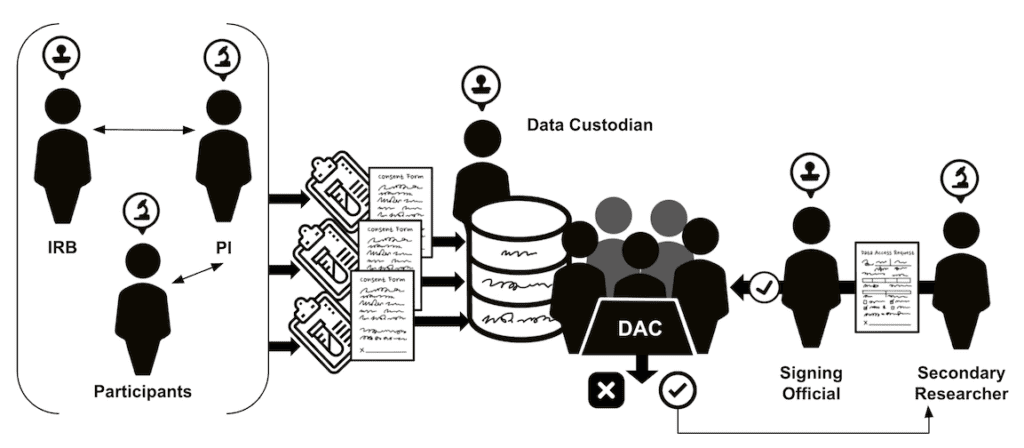
Genomic data for human participants is highly identifiable and therefore often categorized as controlled-access data by virtue of the data sharing language in its consent forms. This means access to the data must be regulated by a data access committee (DAC) who assures the data will be shared and used in accordance with the data use terms in the consent forms.

Therefore, researchers must apply for access to such datasets through their designated DAC. In turn, the DAC must review the application to ensure that the researcher’s intended use of the data aligns with the permitted uses of the data, per the participants’ consent. Unfortunately, since the DACs receive language describing permitted data use and intended use from different parties (IRBs/participants vs. researchers) who use unique and sometimes ambiguous language, they are left with an apples:oranges comparison, which is difficult for them to decipher.

Current data access processes rely on unique, custom narrative text to describe data uses in consent forms and the datasets they represent, as well as in data access requests for those datasets. This makes adjudicating requests difficult if not impossible for DACs in certain cases.

The added weight of the liability involved in granting someone access to data under uncertain terms often leads DACs to undershare rather than overshare, meaning data is unnecessarily locked down, delaying or blocking significant scientific impact entirely. 

Facilitating data access for researchers, by enhancing DAC workflows​

To address this issue and others like it, the Broad Institute developed DUOS (Data Use Oversight System), a suite of software services and policies for managing data access and sharing (more detail here). Principally, DUOS aims to consistently and transparently answer the overarching question posed to DACs: “Does the researcher’s intended use align with the permitted use of the dataset?”

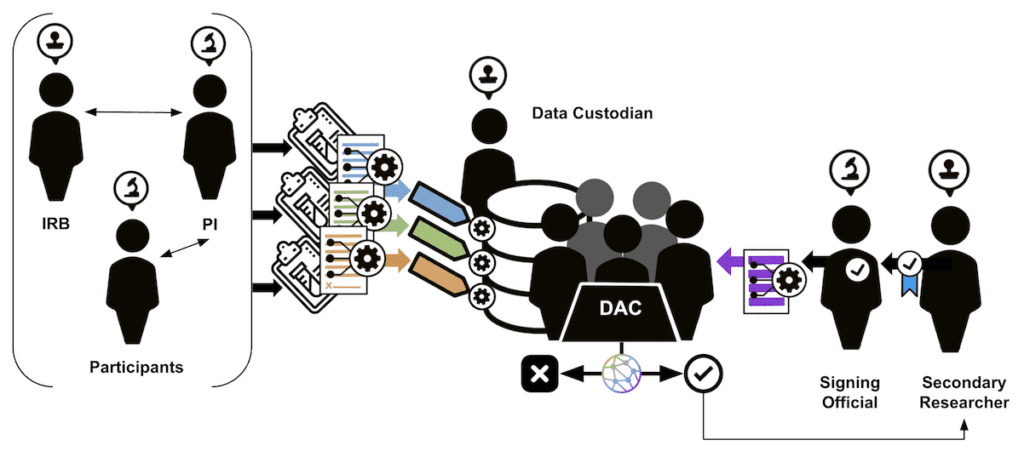
In fact, DUOS aims to do this in a semi-automated fashion by leveraging the GA4GH Data Use Ontology (DUO). The GA4GH DUO provides both human-readable and machine-readable terms and definitions for data use. DUOS utilizes the GA4GH DUO to tag datasets with their permitted use, and data access requests with their intended use in human-readable and machine-readable terms. This standardization allows for DACs and the DUOS matching algorithm to easily determine if a researcher’s intended use aligns with a dataset’s permitted uses in a more apples:apples format, and allows for DUOS to leverage a matching algorithm to suggest a decision to the DAC. The DUOS team is working to further increase the accuracy of the algorithm in making a decision that aligns with that of the DAC. 

The GA4GH DUO allows for standardizing data use in consent forms and the datasets they represent, as well as in data access requests for those datasets. With data use language expressed in standardized and machine-readable terms, adjudicating requests is much easier for DACs and even possible to automate algorithmically.

While this automated matching can alleviate a serious bottleneck, other hurdles and data access and sharing remain. We aim to address those concerns in future articles and through our work on DUOS. In the meantime, please visit our website at www.duos.org for more information and detailed documentation. Thanks for reading and we hope DUOS serves you well!

Broad Institute Expands Data Access Committee to Foster Collaborative Genomic Research

· 2 min read

Cambridge, MA — Broad Institute, a pioneering institution at the forefront of genomic research and data governance, is proud to announce the expansion of its highly regarded Data Access Committee. After five successful years of governing access to internally generated genomic datasets, Broad Institute is opening its doors to welcome researchers and institutions from around the world to leverage its expertise, experience, and established policies.

In response to recent policy initiatives emphasizing the importance of data sharing and the growing need for support from smaller institutions unable to establish their own committees, Broad Institute’s executive committee has made a forward-thinking decision to allow external submissions of genomic data to its Data Access Committee. This groundbreaking development will enable researchers, institutions, and organizations to benefit from our institution’s exceptional resources and knowledge.

By opening the doors to external data submissions, Broad Institute aims to foster a culture of collaboration and innovation in genomic research. This initiative represents a significant opportunity for institutions of all sizes to tap into our institution’s existing system, policies, and wealth of experience. The Data Access Committee will now play a crucial role in facilitating access to not only internally generated datasets but also curated external data.

“Our institution firmly believes in the power of collaboration and knowledge sharing to advance scientific discovery,” said Stacey Donnelly, the Chair of the Broad Institute’s Data Access Committee. “By expanding our Data Access Committee, we are extending an invitation to researchers and institutions worldwide to benefit from our comprehensive data governance framework. Together, we can drive breakthroughs in genomic research and accelerate progress in the field.”

Researchers and institutions interested in submitting their genomic data to Broad Institute’s Data Access Committee are encouraged to write to support@duos.org for detailed guidelines and the submission process. The Committee will meticulously evaluate each submission, ensuring adherence to the highest ethical standards and data protection protocols.

With this bold step, Broad Institute reinforces its commitment to advancing scientific knowledge, fostering collaboration, and promoting equitable access to genomic data. By embracing this innovative approach, the institution aims to catalyze breakthrough discoveries that will benefit humanity as a whole.

Ontology and automation: a powerful DUO for streamlining data access

· 5 min read

Life as a biomedical researcher is a rollercoaster of emotions. One moment you’re marvelling at how technology has revolutionized the field — SO. MUCH. DATA. — and the next, you’re tearing your hair out at how antiquated some of our processes still are — SO. MUCH. PAPERWORK.

Yes, there is a veritable cornucopia of data out there now, but most of the human data is subject to complex access restrictions that can be a huge pain to deal with. To be clear, I’m not talking about basic information security like checking identity and credentials. I’m referring to restrictions on future use and sharing of the data based on the consent of study participants – generally established through study-specific consent forms. These restrictions exist for legitimate reasons, but the way they’ve traditionally been implemented leaves much to be desired.

Data use restrictions and the data access dating game​

Due to the historical lack of standardized consent forms, each study typically uses unique language to describe their data use restrictions. There are usually no templates or standards for researchers who seek to request access to the data; they must describe in their own words what kind of research they intend to do with the data, at times not even knowing which data use restrictions apply.

Who, then, is responsible for granting or denying access to the data? That gatekeeping role belongs to a Data Access Committee (DAC), who is tasked with interpreting the data use requests from researchers and evaluating whether they match or conflict with applicable restrictions. Given the lack of consistency in how data use restrictions are formulated across the biomedical ecosystem, it can be challenging for DAC members to make these decisions with confidence or consistently, so the process takes time and effort. In addition, there’s a lot of variability in the composition and governance of these committees. Some DACs are part of large organizations like NIH and have a formal structure, dedicated staff, and a regular cadence for reviewing access requests, but many within research institutions are simply composed of research faculty members who are expected to perform these duties on top of their full-time job.

To be fair, this cumbersome system predates the advent of cloud-based data sharing, and is just as much of an obstacle in the context of traditional data sharing systems. What’s new is that cloud-based initiatives are contributing to a sharp increase in the number of researchers who are able to find datasets of interest and request access to data. As a result, DACs are increasingly unable to respond to the onslaught of requests they are receiving. When it comes down to it, human committees are simply not going to be able to scale.

Introducing the GA4GH Data Use Ontology… and using it to automate access​

To tackle this challenge, the Global Alliance for Genomics and Health (GA4GH) Data Use and Researcher Identities (DURI) workstream developed an ontological standard for defining data use restrictions. The Data Use Ontology (DUO) provides a controlled vocabulary that data generators can use to formulate data use restrictions and that researchers can use to express their intended purposes when they apply for access.

In addition to solving the challenge of consistent interpretation of data access requests, DUO can also greatly enhance the searchability of access-restricted datasets. By tagging datasets with their usage restrictions, we can enable search algorithms to take into account whether the researcher is likely to be approved to use the data based on their stated research purpose. This empowers researchers to filter out data that would be out of bounds to them anyway, which is a huge time-saver given the increasingly large numbers of available datasets.

Taking this idea one step further, we can move from consistency in the human review of data access requests to automating the data access decision-making process entirely — our team built the Data Use Oversight System (DUOS) to do just that. Using DUOS, you can search for datasets with computer-readable data use restrictions, then apply for access to those datasets with a system-generated, computer-readable data access request. Having computer-readable DUO codes for both the data use restrictions and the data access request, DUOS is able to algorithmically evaluate whether or not the researcher should be granted access to the data!

What is DUOS?​

  • Interfaces to transform data use restrictions and data access requests to machine-readable code (GA4GH Standard)
  • A matching algorithm that checks if data access requests are compatible with data use restrictions
  • Interfaces for the Data Access Committee to adjudicate whether structuring and matching has been done appropriately

For more  details:​

If you’d like to learn more about this powerful duo of ontology and automation, watch the recording of this past GA4GH webinar: Automating access to controlled datasets: the GA4GH Data Use Ontology in action, here on their YouTube channel. I presented our team’s DUOS implementation and talked about how researchers can already use it to access real datasets, and you’ll also hear more about the history of DUO and the work of several other implementers of DUO including the GEnome Medicine Alliance Japan (GEM Japan), Australian Genomics Health Alliance (AGHA), European Genome/Phenome Archive (EGA), DNAStack, Elixir, and the Wellcome Sanger Institute.